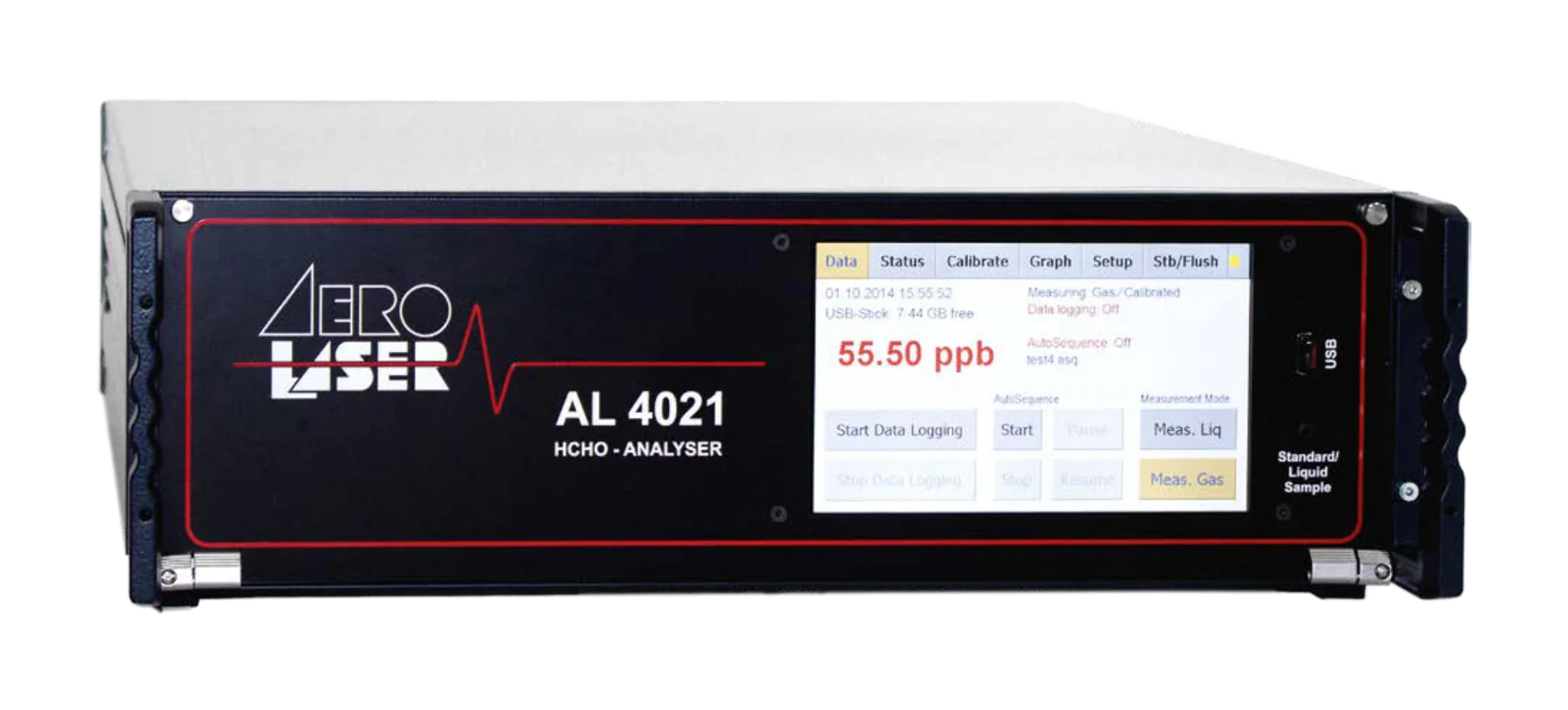


Precision gas and liquid analyzers for the trace concentration range. Made in Garmisch-Partenkirchen, Germany.
Unterfeldstraße 12 · 82467 Garmisch-Partenkirchen · Germany
info@aero-laser.de
Formaldehyde emission testing for wood-based panels, furniture, and building materials — from raw production to finished products. Compliant with EN ISO 717-1, ASTM D6007, ASTM E1333.
The new EU formaldehyde limits (Regulation (EU) 2023/1464, applicable from 6 August 2026) are tightening emission thresholds in furniture, flooring, and building materials. Manufacturers, test laboratories, and independent auditors face stricter requirements — and need instruments that are already norm-referenced and deliver reliable results in the low ppb ranges.
Classic DNPH cartridge + HPLC methods are time-consuming, expensive per sample, and require external lab capacity. Photometric alternatives exist, but lack the sensitivity needed for low-emission materials under the new limits.
Relevant norm: Commission Regulation (EU) 2023/1464 of 14 July 2023 amending Annex XVII to Regulation (EC) No 1907/2006 of the European Parliament and of the Council as regards formaldehyde and formaldehyde releasers
Our application engineers advise on instrument configuration, regulatory compliance, and system integration for your specific task.
Request Quote → Technical Inquiry → Datasheet AL4021 (PDF)How does fluorimetric detection compare to common alternatives? The table below shows the critical parameters for formaldehyde measurement in emission testing.
| Parameter | AL4021 Fluorimetric | IR Absorption | DNPH Cartridge + HPLC | Electrochemical Sensor |
|---|---|---|---|---|
| Detection Limit | <100 ppt (gas) · <150 ng/l (liquid) | <1 ppb (gas), only for pure HCHO in carrier gas | 0.04 ppb | 10 ppb |
| Response Time | ~90 s (T90), delay ~300 s | Few minutes | 24 – 48 hours (lab turnaround) | 60 s |
| Multi-Chamber Capable | Yes (multiple chambers sequential) | Yes | No (one sample at a time) | No |
| Gas + Liquid | Yes — both in one instrument | Gas only | Both (separate preparation) | Gas only |
| Norm Reference | EN ISO 717-1 / ASTM D6007 / E1333 | Not listed | ISO 16000 / VDA 276 | Not listed |
| Cross-Interferences | Documented · very selective | CO₂, CH₄ overlap possible | Very low | Humidity dependent |
| Calibratable On-Site | Yes — traceable | Not always possible | External lab required | Drift, limited traceability |
| Per-Sample Cost | Low (automated; reagent consumption only) | Low | High (per-cartridge + lab) | Medium (sensor replacement) |
Instrument specifications relevant to this application. Full data sheet available for download.
The Hantzsch reaction with fluorimetric detection is only minimally sensitive to other aldehydes and ketones because of the short reaction time.
Benzaldehyde < 1:20000 · Acetaldehyde < 1:10000 · Acrolein < 1:10000 · NH₃ < 1:10000 · Propanal < 1:20000 · Glyoxal < 1:123 · Methanol < 1:50000 · H₂O₂ < 1:100 · O₃ < 1:500
No detectable interference: acetone, SO₂, NO₂, NO, isobutane
Under its air discharge permit, the MDF manufacturer Daiken Southland (New Zealand) has to demonstrate at six locations around the plant that 60 µg/m³ (30-minute average) is exceeded for no more than 0.5 % of the time in a year, and that 100 µg/m³ is never exceeded.
An AL4021 in a mobile measurement container with a computer and a cooling box for the reagents, relocated between the six measurement sites.
At least one month per site, at least 40 weeks per year, 24/7 — with one instrument. At Daiken, the AL4021 is an IANZ-accredited analytical method (ISO/IEC 17025).
Tell us your measurement scenario — we'll recommend the right setup and send you relevant technical documentation.
Precision gas and liquid analyzers for the trace concentration range. Made in Garmisch-Partenkirchen, Germany.