Application — Environmental Monitoring

Precision at Speed

Trace-level CO measurement for research stations, monitoring networks and aircraft — used as a reference instrument by NOAA, GAW and the Chinese Academy of Sciences

MethodVUV fluorescence
Detection RangeCO: 1 ppb – 100 ppm
Sample PhaseGas phase (air)
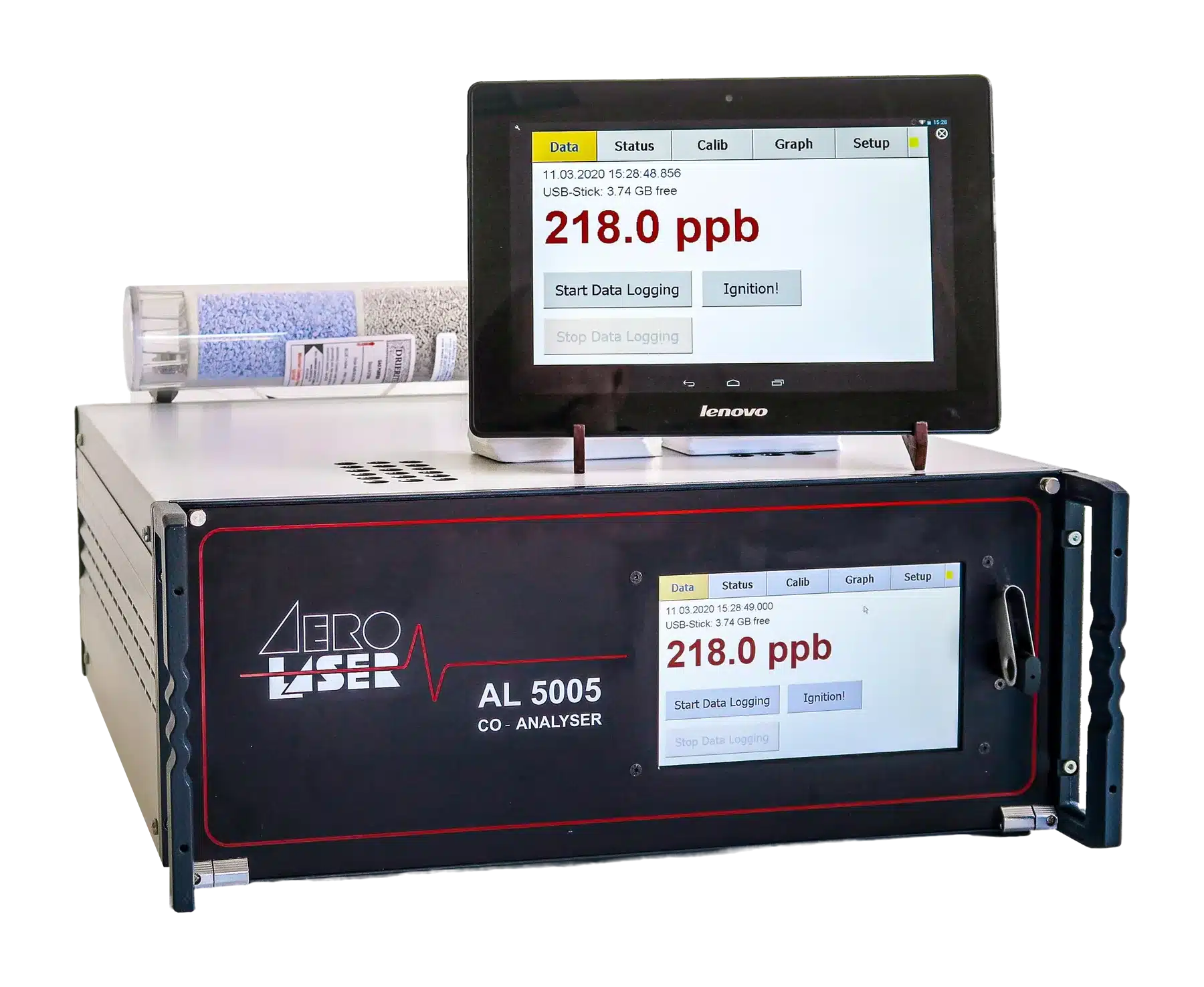
InstrumentAL5005
→ View AL5005 Specs

How Speed, Precision and Reliability Come Together

In background air, CO has to be resolved a few ppb above a clean baseline, often for years without interruption, often at sites that are hard to reach. GAW “Global” stations require better than 90 % data capture and traceability to the GAW CO primary standard — an instrument that drifts or needs frequent servicing fails that requirement long before it fails technically.

Non-dispersive infrared instruments are robust but reach their limit in the low-ppb range. For airborne measurements there is an additional constraint: high spatial resolution requires a response time well below a second.

Relevant norm: WMO/GAW requirements for “Global” stations: > 90 % data capture, traceability to the GAW CO primary standard


How the AL5005 Solves This

100 ms in Real Time
No other CO analyzer measures in real time at 100 ms, so on an aircraft high time resolution becomes high spatial resolution. For flights at high altitude, the low pressure requires a stronger scroll pump.
No Cross-Sensitivities
There are no known interferences except water vapour, which is removed with a Nafion dryer.
The Reference Method
VUV fluorimetry is regarded as the reference method for CO. NOAA, GAW and the Chinese Academy of Sciences use the AL5005 as a reference.
Detection Limits Where the Background Lives
Below 1 ppb CO, linear from 1 ppb to 100 ppm — five orders of magnitude on one calibration.
Designed for Remote Sites
Rugged design for field campaigns, internal zero source, calibration within minutes on little calibration gas, USB logging in stand-alone operation. Instruments installed in 2006 at Cape Verde are still running.
Special Aircraft Version
Aircraft power is typically an unstable 28 V DC; some research aircraft also provide 110/230 V AC or 24 V DC. We adapt the power supply to your platform. Used in the CARIBIC campaign.
Interested in this application?

Discuss your measurement requirement with our specialists.

Our application engineers advise on instrument configuration, regulatory compliance, and system integration for your specific task.

Request Quote → Technical Inquiry → Datasheet AL5005 (PDF)
Used By
GAW and background stations Environmental agencies Atmospheric research institutes Research aircraft and vessels Urban air quality networks Drone service providers
References
  • Cape Verde Atmospheric Observatory (NCAS / University of York)
  • Schneefernerhaus, Zugspitze (GAW)
  • Hohenpeissenberg Meteorological Observatory (DWD, GAW)
  • University of Houston (TexAQS II / TRAMP)

AL5005 — Key Specs

Instrument specifications relevant to this application. Full data sheet available for download.

Detection Limit
<1 ppb at 1 s · <0.8 ppb at 10 s
Linear Range
1 ppb – 100 ppm
Time Resolution
0.1 s real time (stronger scroll pump required at high altitude)
Sample Pressure Range
200 – 1200 mbar (up to approx. 12000 m altitude)
Weight
22 kg

Norms & Standards

WMO/GAW programme (traceability to the GAW CO primary standard)

Cross-Sensitivities

No known interferences except water vapour, which is removed with a Nafion dryer.

Background CO in the Tropical Marine Boundary Layer: The AL5001 at Cape Verde

Situation

The Cape Verde Atmospheric Observatory is a WMO-GAW “Global” station in the tropical marine boundary layer. Global stations require better than 90 % data capture and traceability to the GAW CO primary standard.

Solution

An Aero-Laser AL5001 CO monitor (predecessor of the AL5005), in continuous operation at the observatory since October 2006.

Result

Uninterrupted operation since 2006 at a station that requires better than 90 % data capture. The CO data feed into the European MACC/GMES programme.

Read the full case study →

Frequently Asked Questions

How stable is the instrument over long unattended deployments?
An Aero-Laser AL5001 has been running at the Cape Verde Atmospheric Observatory since October 2006 — a WMO-GAW “Global” station, which requires better than 90 % data capture and traceability to the GAW CO primary standard. Two CO monitors run at the Schneefernerhaus on the Zugspitze under the same programme.
Can the CO analyser be used on an aircraft?
It was designed for it. Response is 0.1 s, so high time resolution becomes high spatial resolution; the sample gas pressure range of 200–1200 mbar covers altitudes up to about 12000 m, and the power supply is adapted to the aircraft: the standard version runs on 110/230 V AC, 24 V DC is available on request, and aircraft usually provide an unstable 28 V DC.

Discuss Your Measurement Campaign

Tell us the site, the species and the time resolution you need — we will tell you what the instrument needs on site to run unattended.