
Precision gas and liquid analyzers for the trace concentration range. Made in Garmisch-Partenkirchen, Germany.
Unterfeldstraße 12 · 82467 Garmisch-Partenkirchen · Germany
info@aero-laser.de
Continuous, absolute H₂O₂ measurement during isolator and cleanroom decontamination — from the aeration phase down to the sub-ppb residue level that decides when filling may restart.
Vaporised hydrogen peroxide is the standard for decontaminating isolators, filling lines and cleanrooms. The critical phase is not the decontamination itself but the aeration afterwards: production may only restart once the residual H₂O₂ has fallen below the level at which it can still affect the product. Every minute of unnecessary aeration is lost line capacity — and every minute too few is a risk to the batch.
Electrochemical sensors and indicator strips give a relative or delayed answer and drift with humidity — precisely the condition inside an isolator after aeration. Near-infrared systems struggle at the low end. What is needed is an absolute concentration, continuously, in the low ppb range, with a calibration that can be reproduced and documented for an audit.
Our application engineers advise on instrument configuration, regulatory compliance, and system integration for your specific task.
Request Quote → Technical Inquiry → Datasheet AL2021SC (PDF)How does enzymatic fluorimetry compare with the sensors typically used around isolators? The table shows the parameters that decide whether a value can be used to release a batch.
| Parameter | AL2021SC Enzymatic fluorimetry (peroxidase) | Electrochemical Sensor | NIR / Absorption | Chemical Indicators / Strips |
|---|---|---|---|---|
| Detection Limit | <100 ppt (gas) | >0.1 ppm | >20 ppb | — |
| Response Time | ~90 s (T90), delay ~300 s | 5 s | Few minutes | — |
| Multi-Chamber Capable | Yes (multiple chambers sequential) | No | No | No |
| Gas + Liquid | Yes — both in one instrument | Gas only | Gas only | — |
| Cross-Interferences | Documented · very selective | — | Particles and dust in the absorption cell highly affect the sensitivity | — |
| Calibratable On-Site | Yes — traceable | — | Not possible by user, has to be sent to manufacturer | Yes |
| Per-Sample Cost | Low (automated; reagent consumption only) | Low | Low | Very high (~100 € per sample) |
Instrument specifications relevant to this application. Full data sheet available for download.
Sterility is a key factor in the filling of pharmaceuticals and vaccines. To separate people from the work area, isolators or RABS (Restricted Access Barrier Systems) are increasingly used for aseptic filling. Prior to filling, an isolator is decontaminated with ~30% H₂O₂ which is fogged on a hot plate. The H₂O₂ fog is then removed from the air by air exchange until a predetermined concentration threshold is reached. In general, this process is monitored with electrochemical sensors that are sensitive down to about 1 ppm. However, this concentration is far too high for many vaccines or enzymes. Here the maximum possible concentrations can be 20–50 ppb. This is where the AL2021SC comes in, at the lower end of the concentration range that can be detected by electrochemical sensors. The AL2021SC measures at the outlet gas stream of the isolator and is not connected to the interior of the isolator. Therefore, it does not need to be sterile itself.
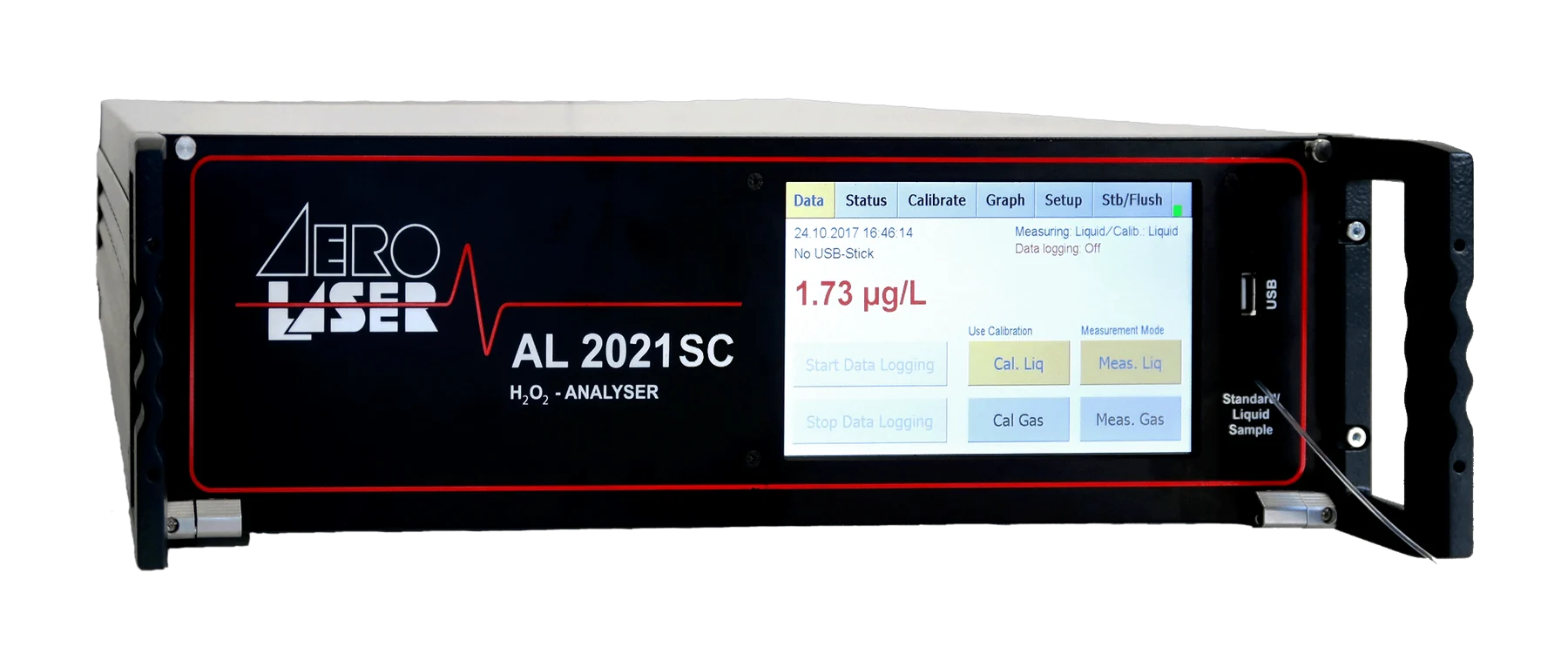
The AL2021SC measures H₂O₂ using a fluorimetric method and is linear from 0.1 ppb to 3000 ppb. The measurement is near real-time and provides live data on the H₂O₂ concentration in the isolator or RABS. Unlike other instruments, the AL2021SC can measure in liquids. Therefore, it can be easily calibrated with a known liquid H₂O₂ standard. This capability makes it very easy to measure the uptake of H₂O₂ into a vial in the isolator.
Tell us your decontamination cycle and the residual level you have to prove — we will tell you whether one or two channels is the right answer.
Precision gas and liquid analyzers for the trace concentration range. Made in Garmisch-Partenkirchen, Germany.