
Precision gas and liquid analyzers for the trace concentration range. Made in Garmisch-Partenkirchen, Germany.
Unterfeldstraße 12 · 82467 Garmisch-Partenkirchen · Germany
info@aero-laser.de
How positrons reveal vacancies, nanovoids and free volume, and how the Life Time Spec brings positron annihilation lifetime spectroscopy (PALS) into everyday laboratory use.
Modern materials research increasingly focuses on understanding and optimising microstructures at the nanometer scale. Open-volume defects such as vacancies, vacancy clusters or nanovoids strongly influence material properties, including mechanical strength, diffusion behaviour, electrical performance and radiation resistance.
Positrons — the antiparticles of electrons — provide a unique probe for these defects. After implantation into a material, positrons rapidly thermalise and diffuse through the lattice. They are preferentially trapped in regions of reduced electron density, such as open-volume defects, before annihilating with electrons.
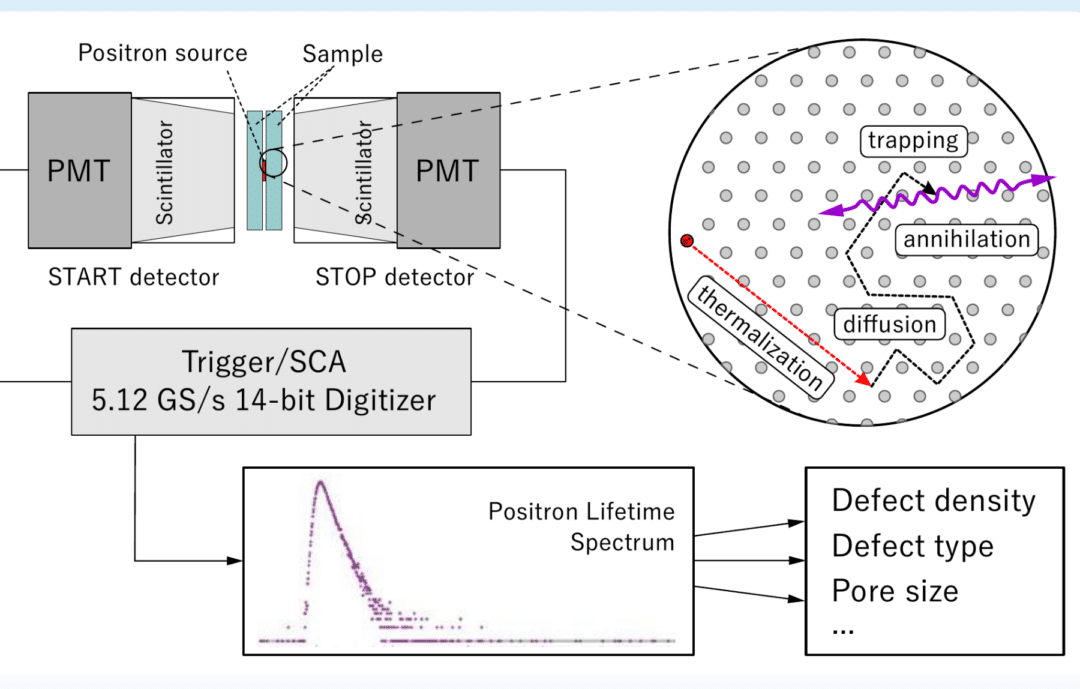
By recording and analysing positron lifetime spectra, Positron Annihilation Lifetime Spectroscopy (PALS) enables:
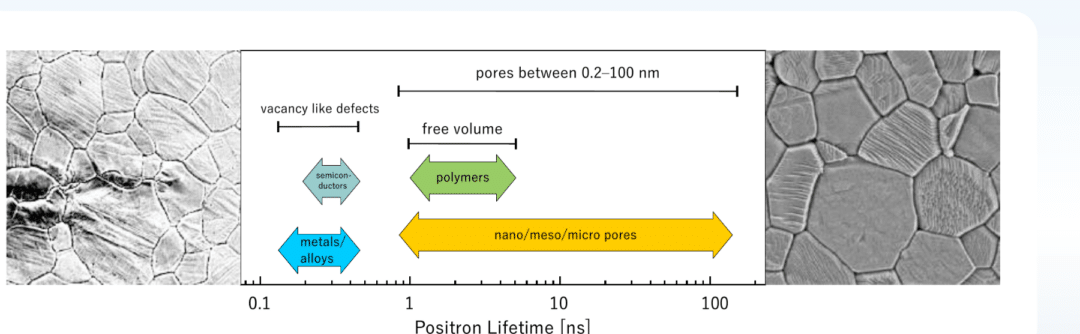
The method is inherently non-destructive and can be applied to a wide range of materials without complex or time-consuming sample preparation. It detects open volumes in solid-state matter over several orders of magnitude, from atomic defects (< 0.3 nm) up to nanovoids and pores (100 nm).
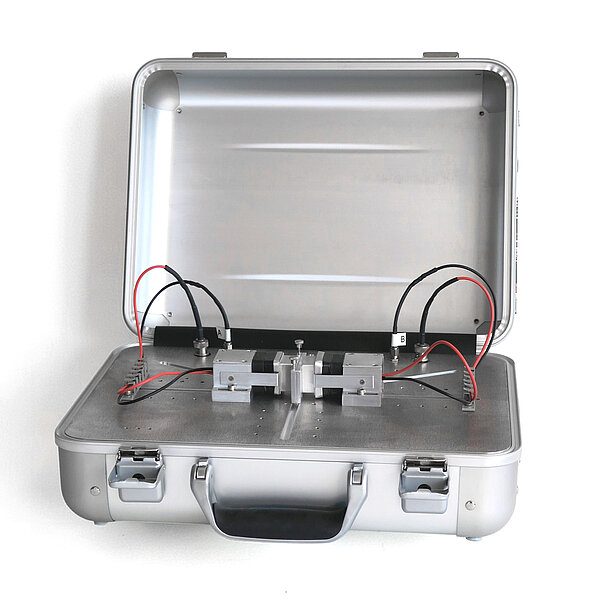
Traditional positron lifetime spectrometers are often associated with large experimental set-ups and specialised infrastructure; PALS was mainly limited to physics institutes and large research facilities. The Life Time Spec was developed as a compact tabletop system for routine laboratory operation in academic and industrial environments.
It is designed for use with low-activity 22Na positron sources below the exemption limit applicable in Germany (1 MBq) [1]. Please check your national regulations.
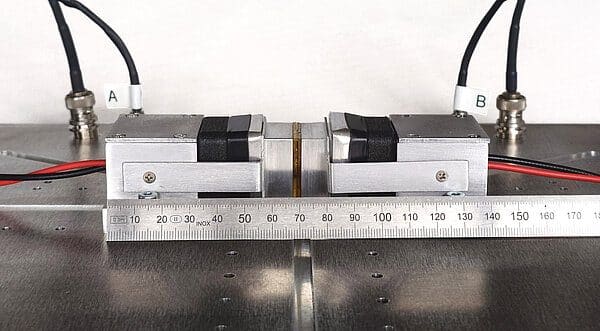
All required electronics are integrated, including the high-voltage supply for the photomultiplier tubes, trigger logic, single-channel analyzers (SCAs) and constant fraction discriminators (CFDs) — no external nuclear electronics are needed. Flexible detector configurations support two-, three- or four-detector arrangements to optimise timing performance, count rate and background suppression.
The Life Time Spec was developed as a joint project between Aero-Laser GmbH and Julius-Maximilians-Universität Würzburg, combining scientific expertise in positron physics with robust industrial instrumentation [2].
The system is based on a high-performance waveform digitizer using DRS4 sampling technology:
Filtering and binning are not fixed during acquisition and can be optimised afterwards during data evaluation. The system is set up with the MaDa+ software, which also displays all relevant parameters and the PALS spectrum.
Overall system time resolution: below 150 ps
PALS links microstructure directly to material performance and supports both R&D and production. Key applications include:
| Field | What PALS contributes |
|---|---|
| Alloy development | Accelerates the optimisation of alloy concepts, supporting improved strength, ductility and fatigue performance. |
| Advanced functional materials | Enables targeted tuning of microstructure by assessing nanoscale free volume and porosity. |
| Semiconductor R&D | High sensitivity to vacancy-related defects, allowing process and material changes to be evaluated at an early stage. |
| Sintering process control | Monitoring densification and nano-porosity, enabling improved parameter selection, higher yield and consistent part quality. |
| Parameter | Value |
|---|---|
| Detection technique | Positron Annihilation Lifetime Spectroscopy (PALS) |
| Geometry | 2-detector set-up, 180°, 90°, 120°; extension up to 4 detectors |
| Scintillator material | EJ-232Q0.5 |
| Positron source | 22Na, low activity, below the exemption limit applicable in Germany (1 MBq) |
| Data acquisition | Digital (DRS4/FPGA), 5.12 GS/s, 14-bit, 2–4 channels in parallel |
| Time resolution | < 150 ps |
| Trigger/SCA/CFD, HV supply | Integrated, digitally controlled by MaDa+ on external PC |
| Data format | Parameterised pulses; filtering and binning possible after measurement |
| Interface / API | Life Time Spec ↔ server: USB · server ↔ client: SSL over TCP/IP, Protobuf · C/C++, Python, Java |
| Weight, dimensions, power | 5 kg, portable, 37 × 27 × 18 cm (W × D × H) · 110/230 V AC, < 20 W |
Speak directly to the engineer responsible for this instrument — no sales detours.
Precision gas and liquid analyzers for the trace concentration range. Made in Garmisch-Partenkirchen, Germany.