
Precision gas and liquid analyzers for the trace concentration range. Made in Garmisch-Partenkirchen, Germany.
Unterfeldstraße 12 · 82467 Garmisch-Partenkirchen · Germany
info@aero-laser.de
How the AL5005 measures carbon monoxide by VUV resonance fluorescence, what it needs to run, and why research aircraft and remote stations rely on it.
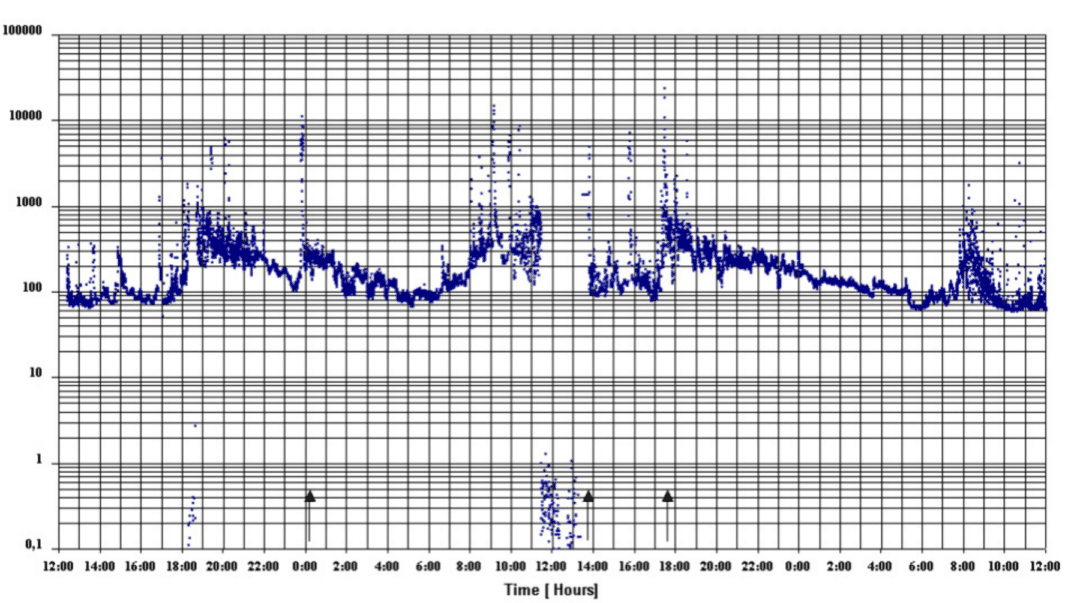
The AL5005 is an ultra-fast carbon monoxide (CO) monitor with a sensitivity below 1 ppb at 1 s and below 0.8 ppb at 10 s. It was specially designed for use on aircraft, where a high time resolution results in a high spatial resolution.
CO is detected by vacuum-UV (VUV) fluorimetry: CO is excited at around 150 nm, and the fluorescence between 160 and 190 nm is detected by a VUV-sensitive photomultiplier followed by a fast counter. The method combines high sensitivity with high selectivity and is linear from 1 ppb to 100 ppm. The basic principle is described in detail by Gerbig et al. [1]
| Item | Requirement |
|---|---|
| Vacuum pump | Membrane pump or scroll pump (recommended) |
| Gas purifier | For the monochromator gas (N2 – 6N) |
| Lamp gas | 0.25 % CO2 (4N5) in argon (6N) |
| Monochromator gas | N2 – 6N |
| Calibration gas | approx. 1 ppm CO in artificial air |
The AL5005 calibrates within minutes, using only a small amount of calibration gas and a built-in zero gas source. The calibration is fully automatic and can be scheduled at custom intervals; calibrations can be loaded, saved, imported and exported.
The concentration is displayed in real time on the 7″ touch panel and can be logged via RS-232 (e.g. with the SqeezeDat software) or TCP/IP. Unlike the predecessors AL5001 and AL5002, the AL5005 stores data on a USB stick for stand-alone operation. Remote control is possible from a PC, smartphone or tablet.

Simple operation and a clearly arranged parameter display on the touch-enabled front panel. The rugged instrument is designed for field campaigns in rough environments as well as for laboratory use.

| Criterion | Aero-Laser AL5005 | IR absorption (CRD, others) |
|---|---|---|
| Measuring principle | Gas-phase VUV fluorimetry | Infrared absorption spectroscopy |
| Time resolution | Real time, 100 ms | 60 s |
| Accuracy | 2 % of full scale | ± 1 % to ± 5 %, depending on model |
| Detection range | approx. 1 ppb – 100 ppm | 40 ppb – 1000 ppm |
| Linearity | Linear over 5 orders of magnitude | Non-linear, but correctable |
| Zero drift | < 5 ppb | < 100 ppb |
| Temperature range | > 0 – 45 °C | 20 – 30 °C |
The fluorimetric detection of CO is linear over several orders of magnitude. This was tested by the Swiss Federal Laboratories for Materials Science and Technology (Empa) in Dübendorf, Switzerland, in two correlation tests with separate calibrations for high and low levels. The result shows excellent linearity of the Aero-Laser CO analyzer family.
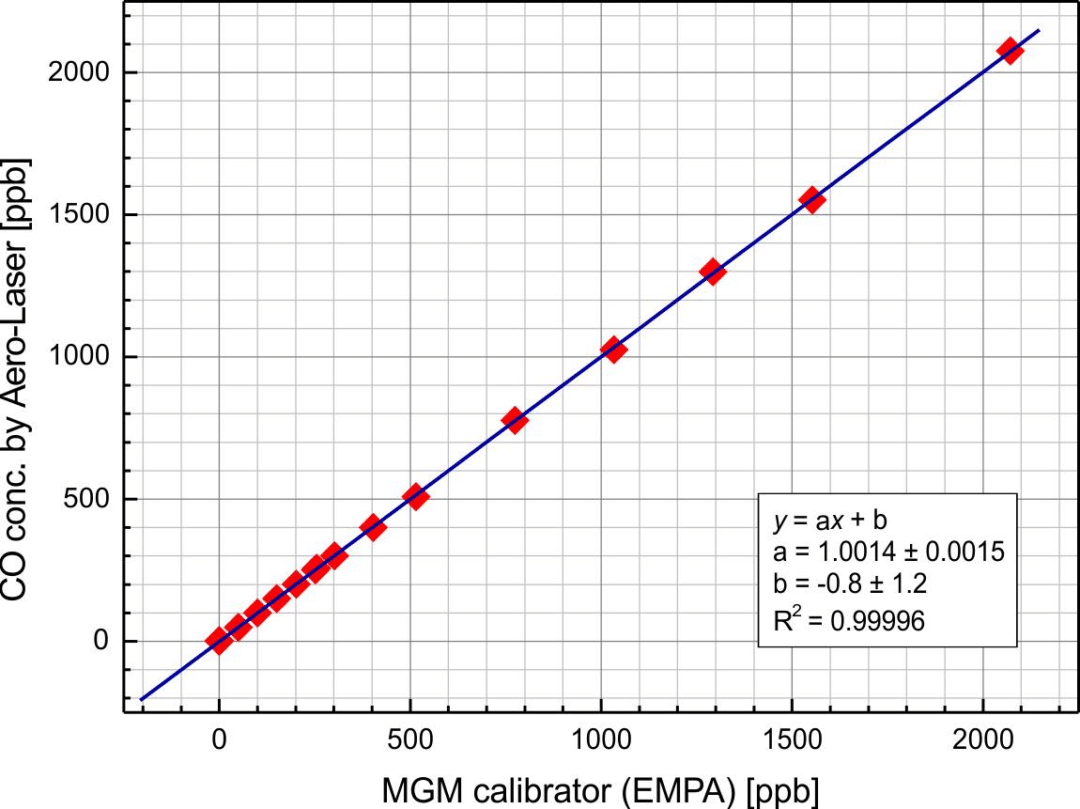
The AL5005 is widely used at remote research stations, on research ships and on aircraft, where very low detection limits, high sensitivity, fast response, high temperature stability, low zero drift and a wide linear range are required. The standard version runs on 110/230 V AC, 24 V DC is available on request, and for aircraft, which usually provide an unstable 28 V DC, the supply is adapted to the platform; sample gas pressures from below 200 to 1200 mbar correspond to altitudes of up to 12000 m.
Research organisations and universities using the instrument include NOAA, GAW, UBA, CAMS, NIER, FAAM, UCAR/NCAR, CARIBIC, DWD, KIT, Empa, JPL, MPI and the Fraunhofer Society.
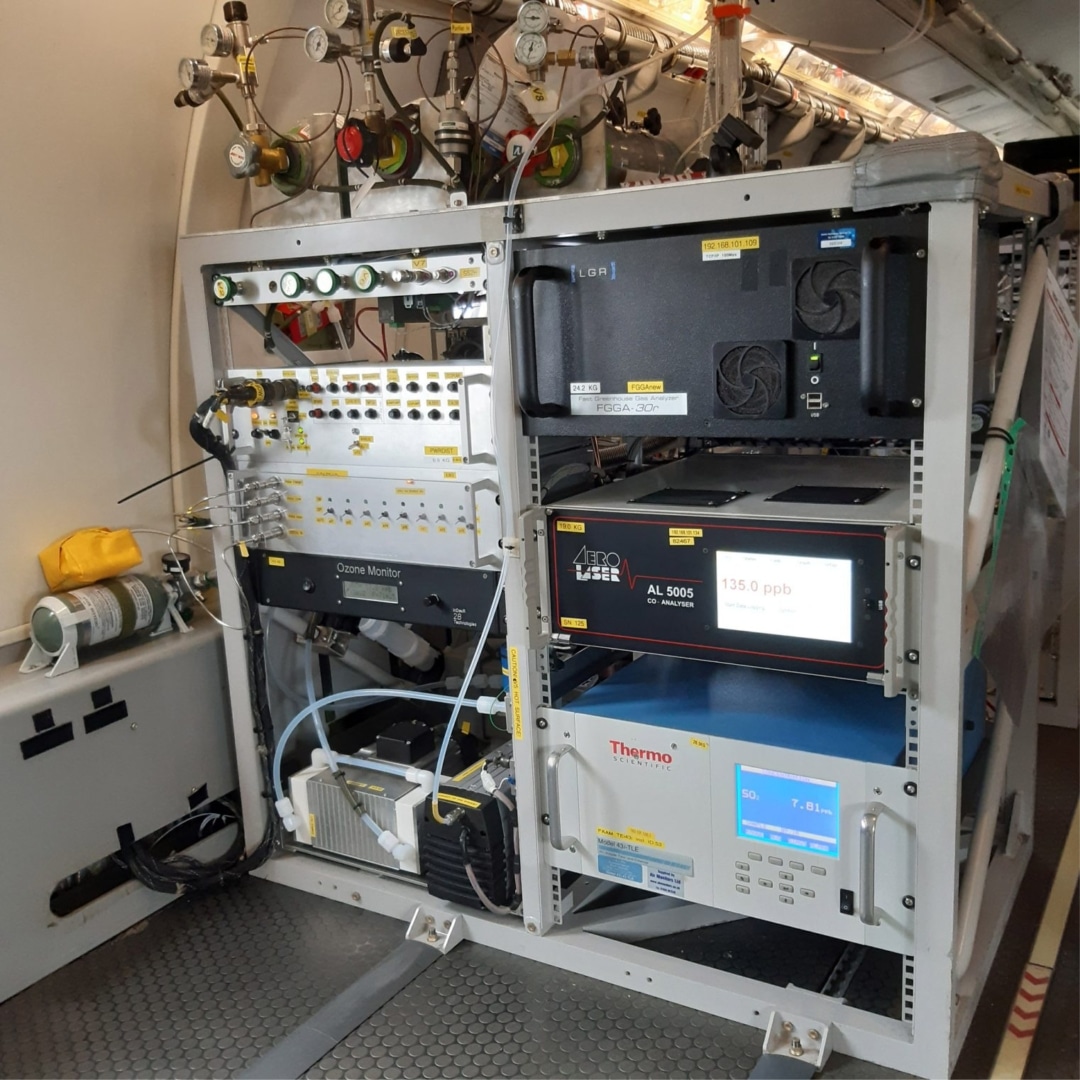
Worldwide scientific campaigns with the AL5005 and its predecessors AL5001/5002 include VOCALS-REx, CARIBIC, AMMA, INTEX-B, INCA, IAGOS, ACE-Asia, TexAQS I/II, SHADE, ITOP-ICARTT, COBRA, ESCOMPTE, MOPITT, SAFARI 2000, SCOUT-03, CRYSTAL-FACE, HUMPPA-COPEC 2010, POLARCAT and RICO.
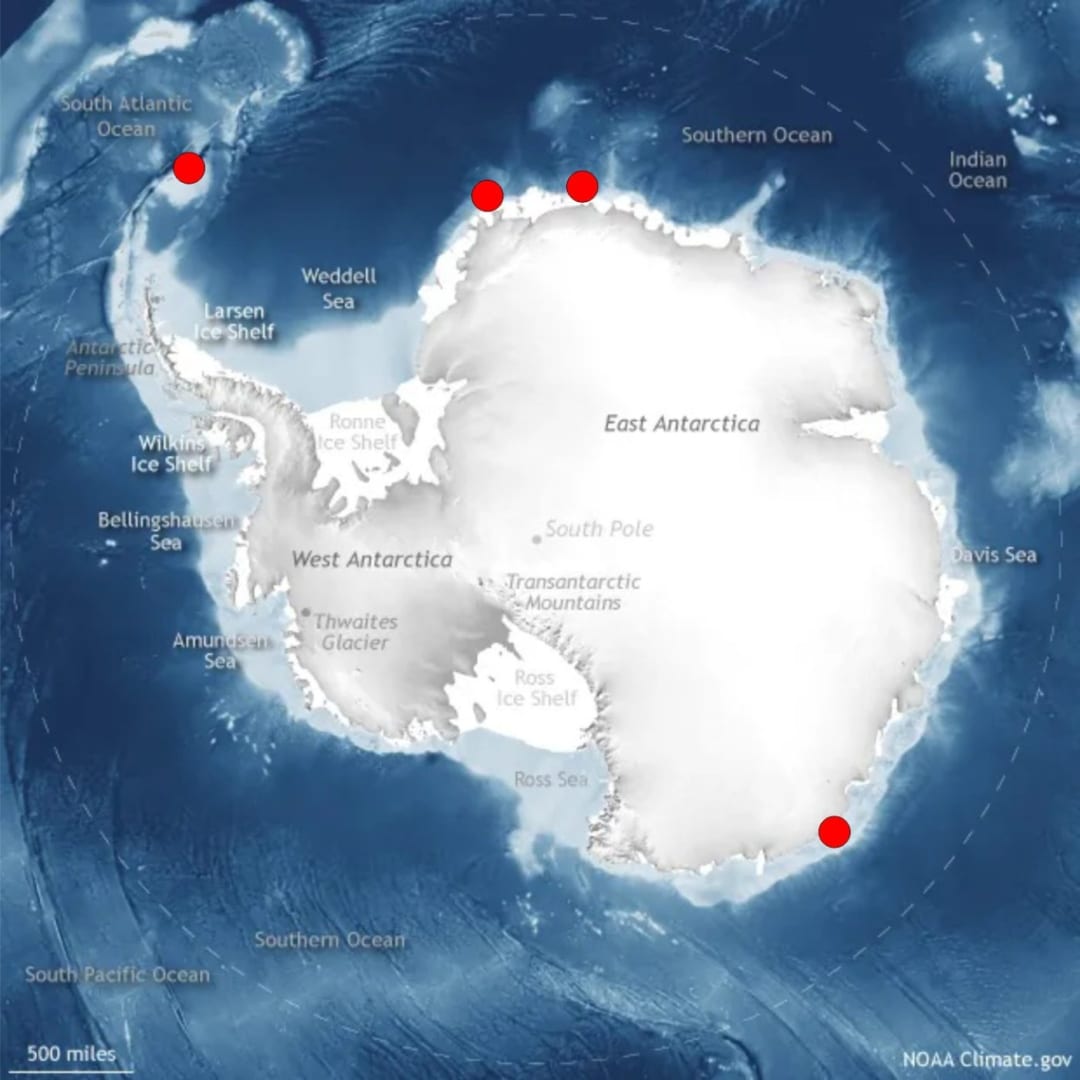
In remote research settings such as Antarctica, the robustness and stand-alone operation of the AL5005 come to the fore. The instrument is in use at the Neumayer (Germany), Dumont d’Urville (France), King Sejong (Republic of Korea) and Troll (Norway) stations.
Speak directly to the engineer responsible for this instrument — no sales detours.
Precision gas and liquid analyzers for the trace concentration range. Made in Garmisch-Partenkirchen, Germany.