
Precision gas and liquid analyzers for the trace concentration range. Made in Garmisch-Partenkirchen, Germany.
Unterfeldstraße 12 · 82467 Garmisch-Partenkirchen · Germany
info@aero-laser.de
How the AL2021 measures hydrogen peroxide in gases and liquids, how the dual-channel and single-channel versions differ, and how they are used in pharmaceutical isolators and ultrapure-water lines.
The AL2021 is a continuous analyzer for hydrogen peroxide (H2O2) in gaseous and liquid samples, sensitive down to the sub-ppb range.
Detection is based on the liquid-phase reaction of peroxides with p-hydroxyphenylacetic acid, catalysed by the enzyme peroxidase. The reaction produces a fluorescent dimer that is excited at 326 nm and detected between 400 and 420 nm. The fluorimeter uses a UV LED for excitation and a photomultiplier for detecting the fluorescent light. The reaction is sensitive to all peroxides in the solution, but fastest for H2O2.
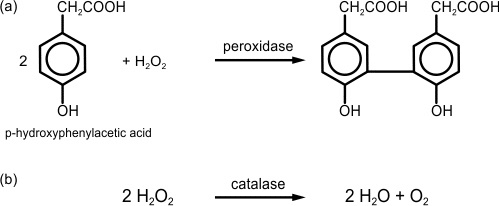
To separate the H2O2 signal from that of other peroxides, the AL2021 uses two parallel channels, each with its own reactor and fluorimeter. In channel B, H2O2 is first destroyed selectively by the enzyme catalase.
The H2O2 concentration is the difference between both signals, corrected for the destruction efficiency of the catalase solution.


For gaseous samples, H2O2 is first dissolved in a stripping solution: air and stripping solution are pumped continuously through a stripping coil at known flow rates and separated afterwards in a glass separator. The H2O2 concentration in air is calculated from the concentration in solution and the ratio of air to stripping-solution flow.
Coil size and flow rates are optimised for quantitative stripping of H2O2. Other peroxides are less soluble; their stripping efficiency probably varies between 60 % (methyl hydroperoxide) and 100 % (H2O2). Channel B therefore gives only an approximate, relative measure of other peroxides in air that follows their concentration changes [1].
The dual-channel design is needed to separate H2O2 reliably from other peroxides in environmental air. Where a gaseous or liquid sample contains only H2O2 — as in the decontamination of isolators or in drinking water — one channel without catalase is sufficient. The single-channel AL2021SC is designed for these measurements; the AL2021SCL is a single-channel version for liquid samples only.
| Version | Design | Samples | Typical applications | Linear range (spec sheet) |
|---|---|---|---|---|
| AL2021 (environmental) | Dual channel, distinguishes between H2O2 and other peroxides | Gas and liquid | Environmental research, atmospheric photochemistry | 0.1–3000 ppb (gas) 0.1 µg/L – 3 mg/L (liquid) |
| AL2021SC (pharma) | Single channel | Gas and liquid | Filling of injectables into syringes in isolators/RABS, e.g. vaccines, botox, enzymes; drinking water control | 0.1–3000 ppb (gas) 0.1 µg/L – 3 mg/L (liquid) |
| AL2021SCL (semiconductor) | Single channel, liquid only | Liquid | Ultrapure water (UPW) in semiconductor manufacturing | 0.1 µg/L – 3 mg/L |
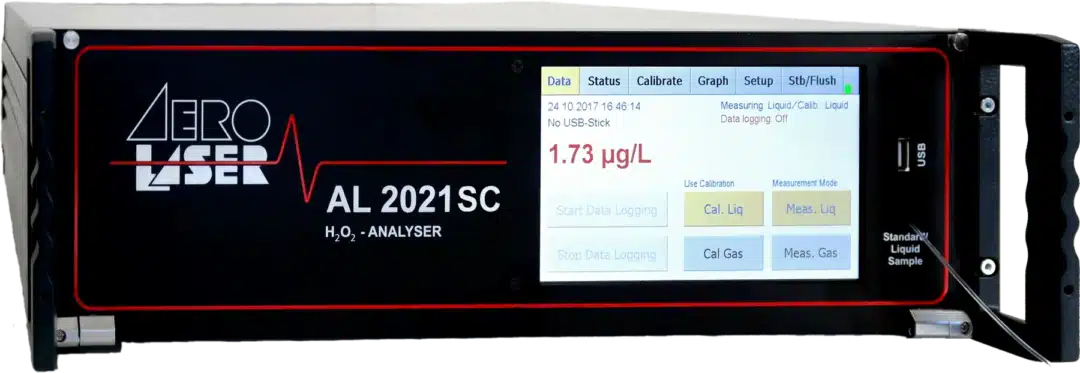
In the AL2021SC, H2O2 from the sample gas is brought into aqueous solution in a stripping coil. The solution is then forwarded to a reactor, where the enzymatic reaction takes place; the signal of the reaction product is measured by a photomultiplier.
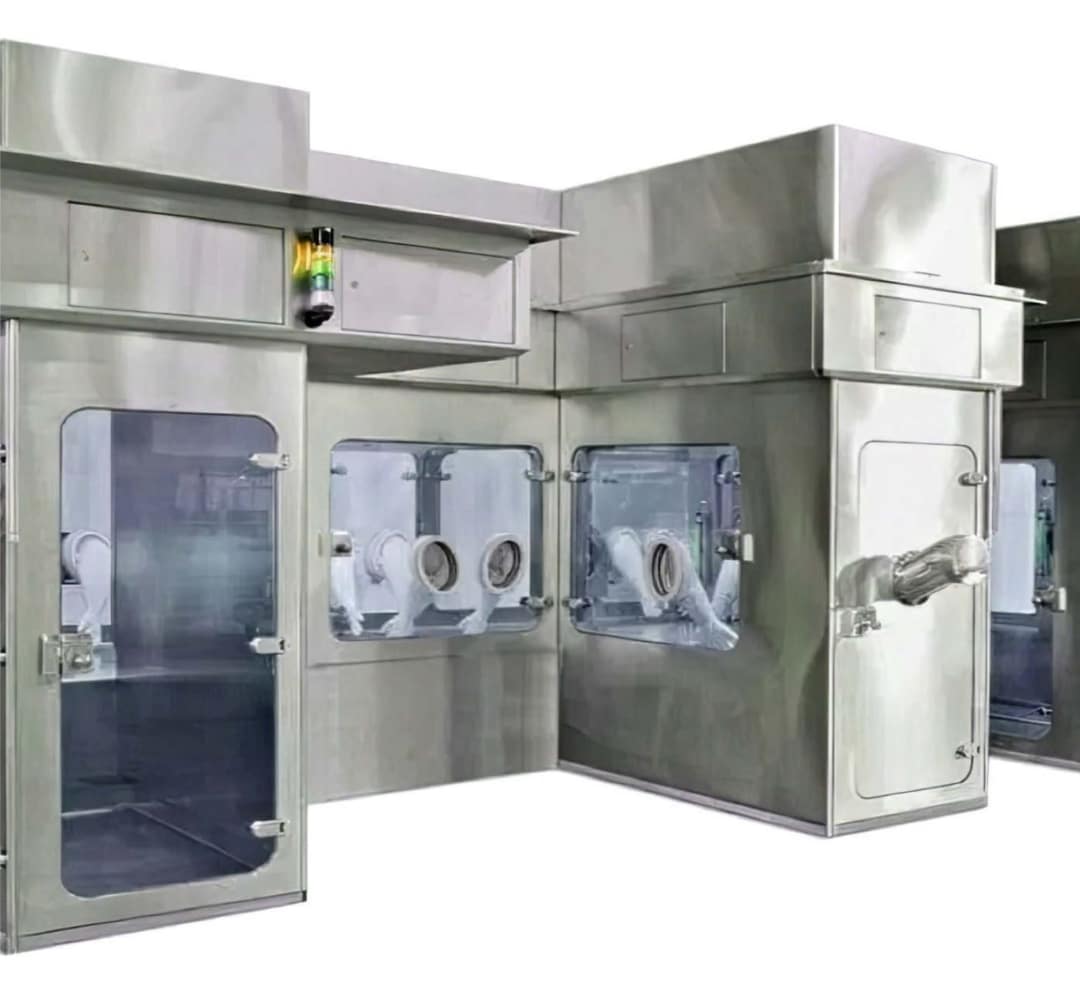
Sterility is the key factor in the filling of pharmaceuticals and vaccines. Isolators or RABS (Restricted Access Barrier Systems) separate people from the work area. To ensure sterility, the isolator is decontaminated with vaporised H2O2 (VHP); the H2O2 is then removed by air exchange until a predetermined concentration threshold is reached.
This process is usually monitored with electrochemical sensors that are sensitive down to about 1 ppm. For many vaccines or enzymes this is far too high: the maximum possible concentrations can be 20–50 ppb, depending on the substance, otherwise the product will be destroyed.
The AL2021SC measures H2O2 near real-time at the outlet gas stream of the isolator. As it is not connected to the interior, it does not need to be sterile itself. Because it handles gas and liquid samples, it can also measure the uptake of H2O2 from the isolator air into the injectable during filling, and it is calibrated with an easy-to-prepare liquid standard. With the included remote software, decontamination can be monitored without entering the clean room.

| Criterion | Aero-Laser AL2021SC | IR absorption (CRD) |
|---|---|---|
| Measuring principle | Peroxidase reaction, fluorimetric, using liquid reagents. Measures gaseous and liquid samples. | Infrared absorption spectroscopy. Measures gaseous samples only. |
| Calibration | Liquid H2O2 standard: easy, inexpensive, reliable, fully traceable. | Not possible by the user; the instrument has to be sent to the manufacturer. |
| Detection range | Gas: 0.1 – 3000 ppb Liquid: 0.1 µg/L – 3 mg/L |
Gas: > 20 ppb – 100 ppm |
| Selectivity | Highly selective, even at low ppb levels. | Interferences from other analytes, water (vapour), dust and particles. |
| Data quality | Stable. | Non-quantifiable zero offset, noisy, long-term drift. |
| Robustness | Resistant to particles and dust, easy to clean and maintain. | Particles and dust in the absorption cell strongly affect sensitivity; the cell cannot be cleaned easily. |
As structures on the die become smaller and thinner, the purity of the ultrapure water (UPW) used in production becomes increasingly critical. During UV treatment, total organic carbon (TOC) is broken down, which always produces H2O2 by recombination of OH radicals. Even the lowest H2O2 concentrations — less than 10 µg/L — can corrode the wafer surface or conductive paths such as copper, causing irreversible damage, particularly in processes with ultra-thin layers [2]. Typical H2O2 levels in UPW are 5–25 µg/L.
A downstream catalyst can significantly reduce the H2O2 concentration in the process water. To reduce downtime, sufficient H2O2 reduction and continuous water quality control can only be achieved by online monitoring before and after the catalyst. The AL2021SCL combines a peroxidase reaction with fluorimetric detection and is therefore both highly sensitive and highly selective.
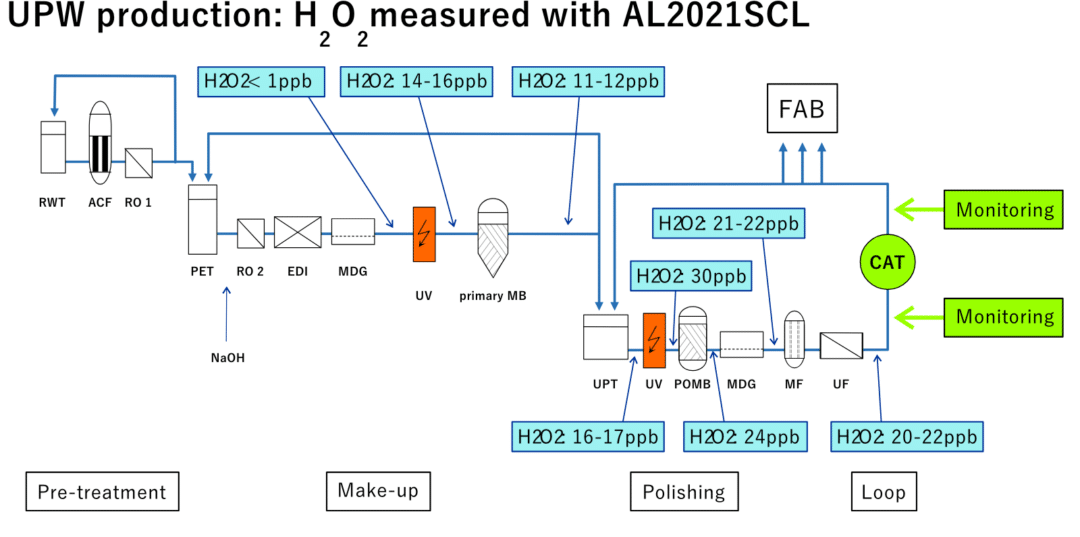

H2O2 is present in higher concentrations at any point of the production line after UV treatment. Without removing it, H2O2 enters the fab and causes serious quality problems. Online monitoring before and after catalyst treatment shows whether the reduction is sufficient.
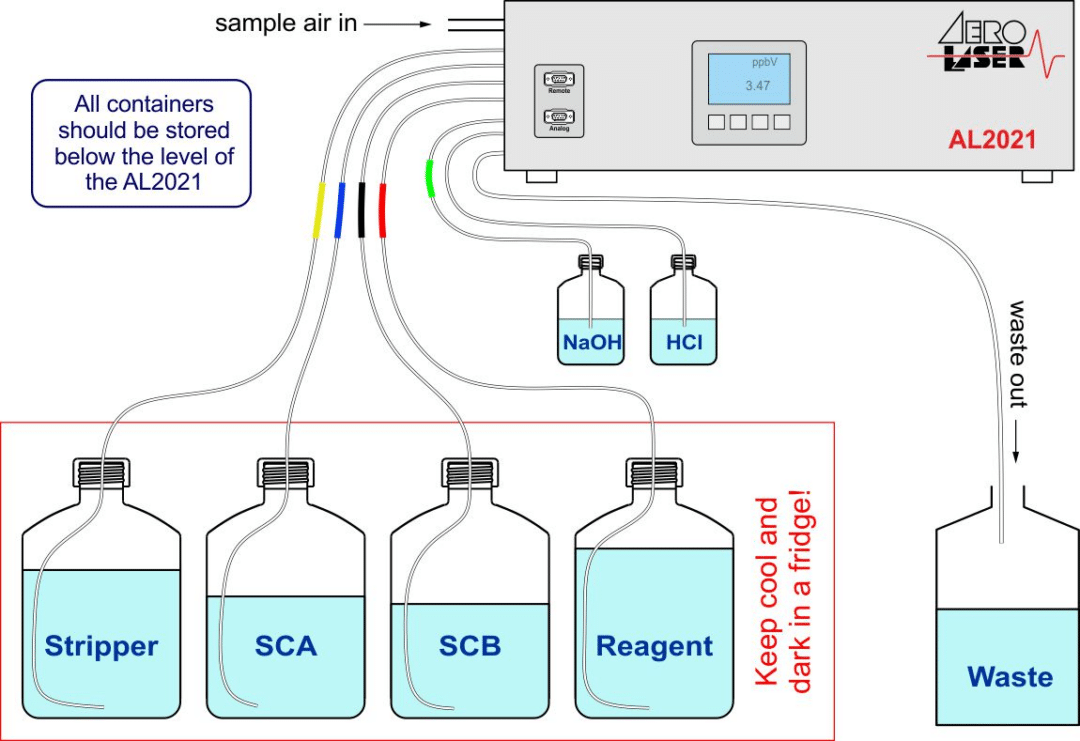
Automatic routine measurements require regular calibration. As liquid H2O2 standards are unstable, they are prepared freshly before use and kept cool and dark even during calibration. For automatic calibrations, the AL2021 can be equipped with an internal H2O2 permeation source (optional).
The enzymatic reaction with peroxidase has only two known significant interferences, from ozone and nitric oxide. A wide range of further substances shows no interference.
| Substance | Cross-sensitivity |
|---|---|
| O3 | < 1 : 3500 |
| NO | < 1 : 8000 |
| Other peroxides | – (separated via channel B) |
SO2, PAN, NO2, glyoxal, isobutane, isobutylene, 1-butane, formaldehyde, benzene, toluene, methanol, acetone, methylamine, dimethylamine, n-butane, cis-2-butene, trans-2-butene; ions such as iodide, chloride, bromide, nitrate, phosphate and benzoate.
Speak directly to the engineer responsible for this instrument — no sales detours.
Precision gas and liquid analyzers for the trace concentration range. Made in Garmisch-Partenkirchen, Germany.