Life Time Spec
Tabletop Instrument for Atomic-Scale Defect Analysis

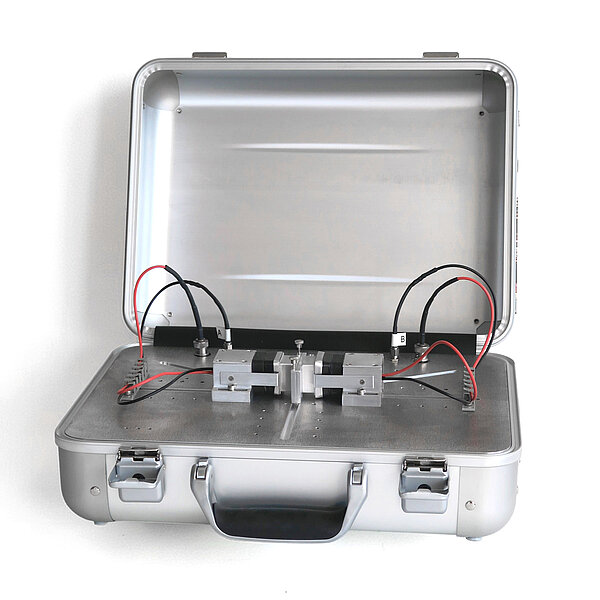
The Life Time Spec (LTS) is a compact positron lifetime spectrometer designed for the non-destructive characterization of nanoscale defects in materials using Positron Annihilation Lifetime Spectroscopy (PALS).
Developed as a joint project between Aero-Laser GmbH and Julius-Maximilians-Universität Würzburg, the system combines scientific expertise in positron physics with robust industrial instrumentation.
Defect Analysis at the Nanometer Scale
Modern materials research increasingly focuses on understanding and optimizing microstructures at the nanometer scale. Open-volume defects such as vacancies, vacancy clusters or nanovoids strongly influence material properties including mechanical strength, diffusion behavior, electrical performance and radiation resistance.
Positrons — the antiparticles of electrons — provide a unique probe for investigating these defects.
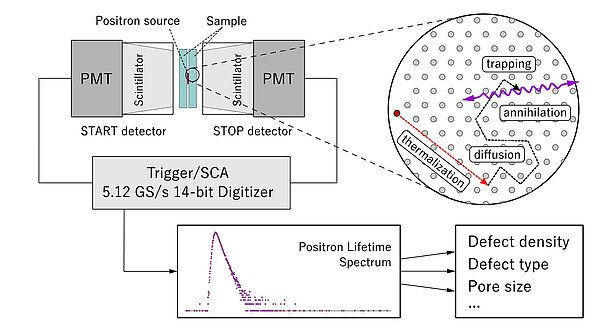
After implantation into a material, positrons rapidly thermalize and diffuse through the lattice.
They preferentially become trapped in regions of reduced electron density, such as open-volume defects, before annihilating with electrons.
Positron Annihilation Lifetime Spectroscopy
By recording and analyzing positron lifetime spectra, Positron Annihilation Lifetime Spectroscopy (PALS) enables:
▶ Detection of vacancy-type defects
▶ Characterization of nanovoids and porosity
▶ Quantification of defect density
▶ Monitoring of microstructural evolution
▶ Investigation of fatigue and radiation-induced damage
The method is inherently non-destructive and can be applied to a wide range of materials without complex or time-consuming sample preparation.
Compact Implementation for Laboratory Use
Traditional positron lifetime spectrometers are often associated with large experimental setups and specialized infrastructure. The Life Time Spec has been developed to enable routine laboratory operation in both academic and industrial environments.
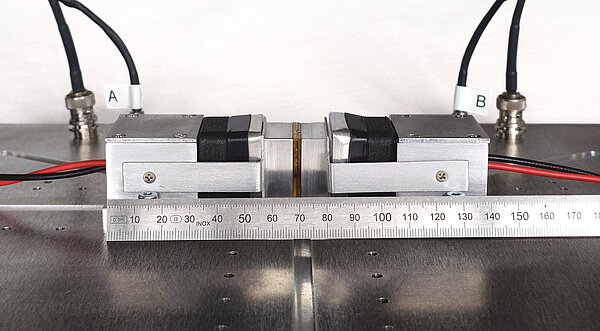
Its compact tabletop geometry allows measurements using low-activity ²²Na positron sources below regulatory exemption limits, simplifying installation and handling.
Flexible detector configurations support two-, three- or four-detector arrangements, enabling optimization of timing performance, count rate and background suppression.
Digital Timing Architecture
The system is based on a high-performance waveform digitizer using DRS4 sampling technology, providing:
▶ Sampling rates up to 5.12 GS/s
▶ 14-bit vertical resolution
▶ Up to four acquisition channels
▶ Integrated digital trigger and single-channel analyzer (SCA) functionality
The resulting overall system time resolution is below 130 ps, enabling precise lifetime measurements even in complex defect environments.
Application Areas
The Life Time Spec supports materials research and development in areas such as:
▶ Semiconductor materials and device reliability
▶ Metallic alloys and fatigue studies
▶ Polymers and porous materials
▶ Energy storage and functional materials
▶ Fundamental defect physics
By bringing positron lifetime spectroscopy into compact laboratory instrumentation, the system complements established characterization techniques and enables new experimental approaches.
Specifications
| Detection technique: | Positron Annihilation Lifetime Spectroscopy (PALS) |
| Geometry: | 2-detector setup, 180°, 90°, 120°. Extension up to 4 detectors possible |
| Scintillator material: | PMMA, BC422Q0.5 |
| Positron source: | ²²Na, activity below regulatory limits |
| PALS data acquisition: | Digital (DRS4/FPGA) at 5.12 GS/s, 14-bit resolution, 2-4 channels parallel |
| Time resolution: | <130 ps |
| Trigger/SCA/CFD: | Integrated, digitally controlled by software MaDa+ on external PC |
| HV supply for PMTs: | Integrated, digitally controlled |
| Data filtering/background reduction: | Digital physical filters |
| Data format: | Parameterized pulses. Filtering and binning possible after measurement |
| Interface: | Server/Client based, TCP/IP - ProtoBuf |
| API: | C/C++, Python, Java via ProtoBuf |
| Weight and dimensions: | 5kg, portable (wdh: 37cm × 27cm × 18cm): |
| Power requirements: | 110VAC/230VAC, <20W |